 SnapPose
Almost everyone feels stiff when a camera points at them. The feeling is not a sign that you are unphotogenic. It is the body doing what bodies do when they are watched: the shoulders rise, the jaw tightens, the hands disappear. The fix is not a magic pose. It is a handful of small habits you can learn in an afternoon and use for portraits, travel photos and profile pictures alike.
Why you freeze
When someone says “ready?”, most people stop moving and try to hold a perfect pose. Holding a position makes muscles tense, and tense muscles show up in photos as a flat smile, lifted shoulders and a neck that seems too short. A camera is simply very good at recording tension.
So the goal is not to find a better position to hold. The goal is to avoid holding at all. Every habit below either releases tension or gives you something to do instead of “posing”.
Start with your feet
Your feet decide the shape of the whole body. Standing square to the lens with both feet side by side makes you look wide and flat, like an ID photo. Turn your body about 45 degrees away from the camera and put most of your weight on the back foot. The front leg can relax and bend a little.
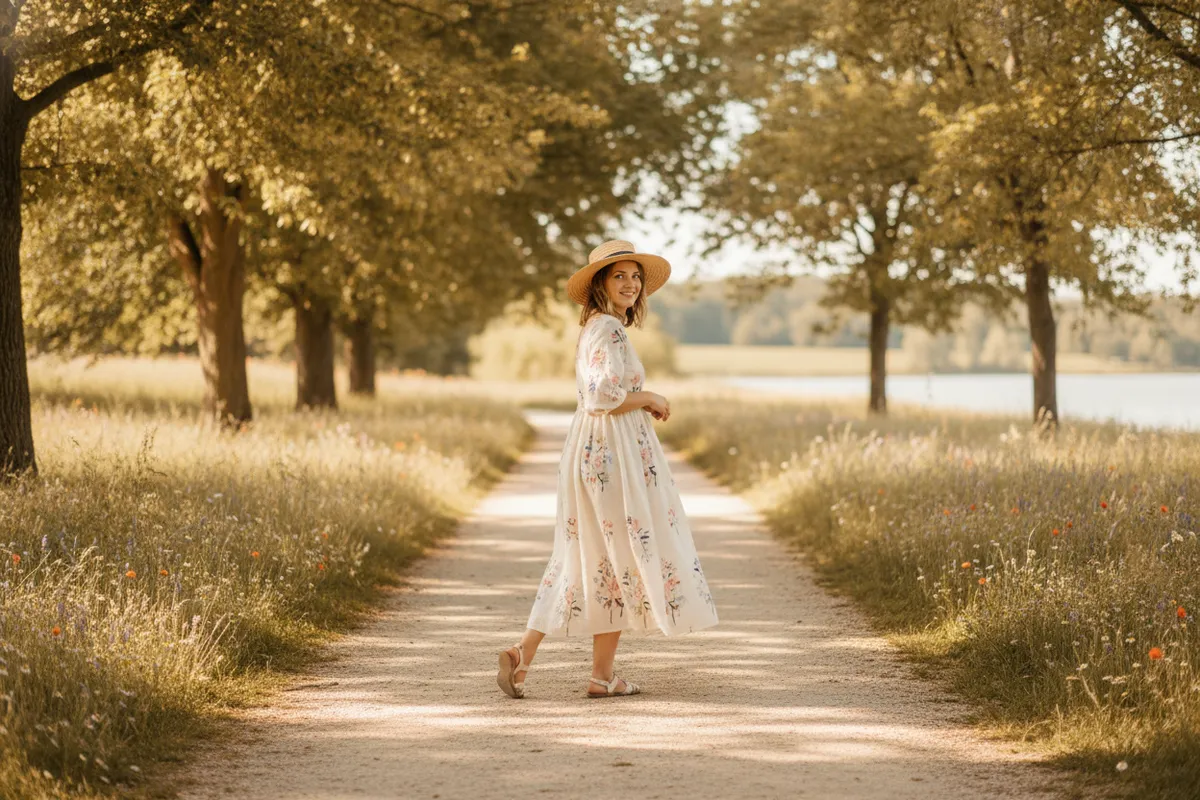
That small turn changes more than you would expect. The hips tilt, the shoulders follow, and the line of the body becomes a gentle curve instead of a block. You can still turn your head back toward the camera.
Give your hands a job
Hands feel awkward because they have nothing to do. Give them a purpose and they stop being a problem. Hold a coffee cup, tuck a thumb into a pocket, touch your collar, adjust a bag strap or rest a hand on a railing or the back of a chair.

Two things to avoid: clenched fists, which read as nervous, and both hands hidden behind your back, which makes the shoulders look pulled. If you have nothing to hold, let the fingers stay loose and slightly apart, as if you were resting them on a table.
Shorten the neck, define the jaw
A common trick from portrait photographers is to push your forehead slightly toward the camera and lower your chin a little. It feels odd in a mirror, but it defines the jawline and avoids the soft double chin that appears when you pull the head back.
Keep it small. A few centimetres of movement is enough. If it feels like a turtle, you have gone too far.
Look at something that is not the lens
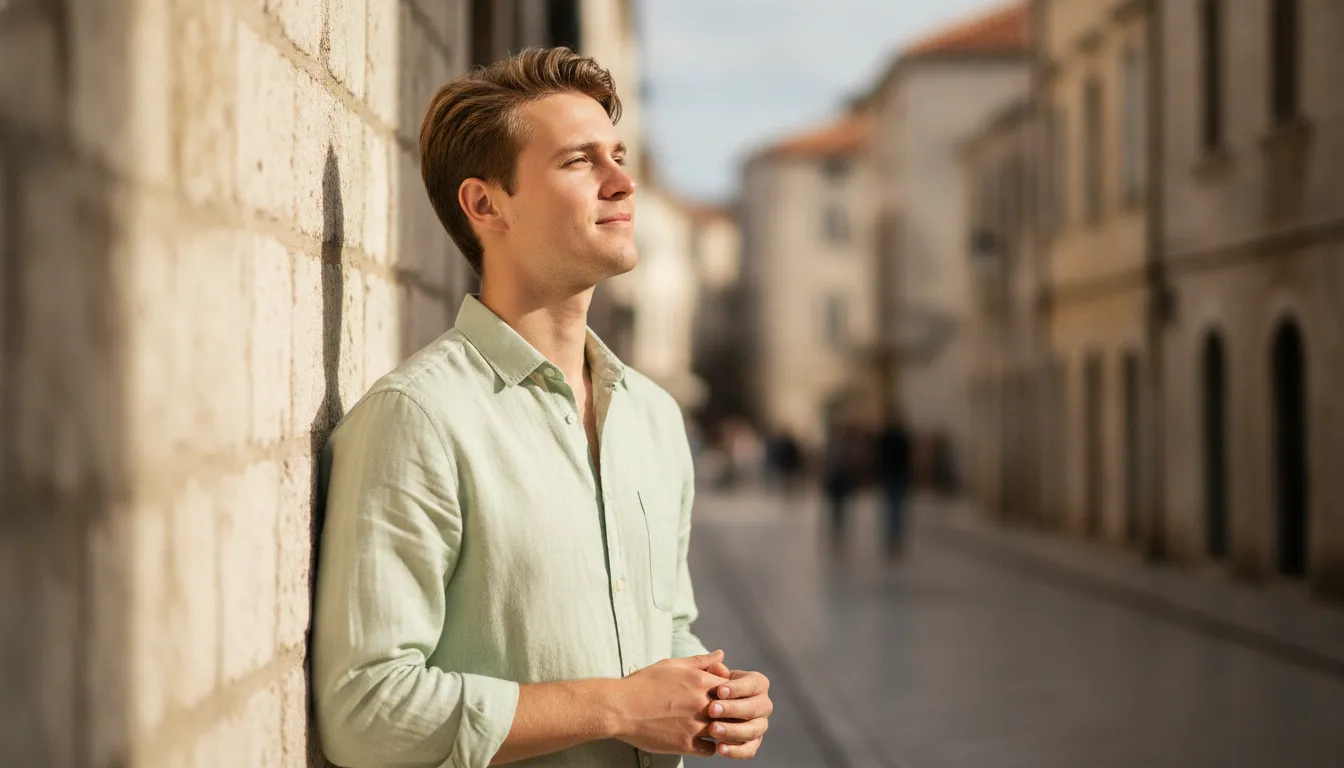
Looking straight into a lens can feel intense, and the intensity shows. Look past it at a friend, a window, a building or a point in the distance. You can also look down at your own hands, or at something in the scene you would naturally notice.
Ask the photographer to take a burst while your eyes move. Then choose the frames where your expression looks like you are thinking about something, not about the camera.
Move between shots
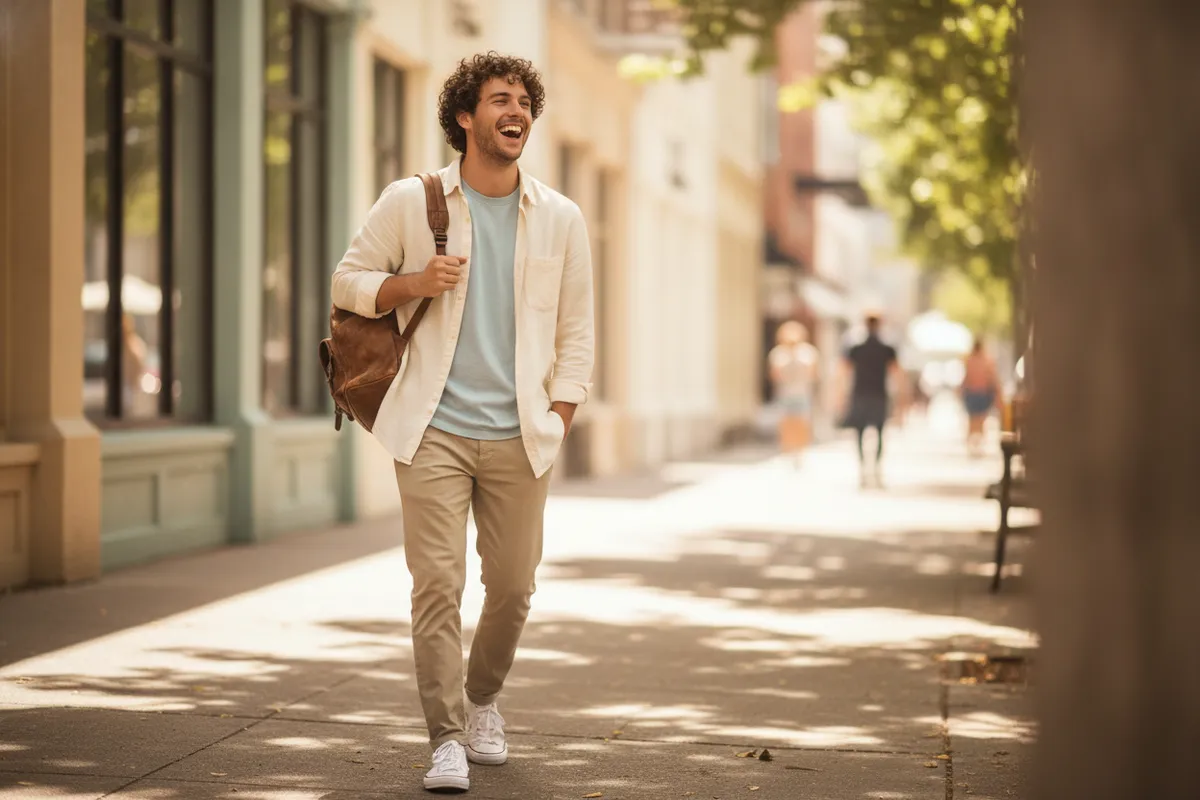
Static poses look stiff because the body locks. Keep moving: walk three steps, turn your head, adjust your jacket, laugh at nothing in particular. The photographer takes frames throughout, and the best one is almost always between two poses, not the pose itself.
If you are taking a photo of yourself with a timer, do the same. Press the button, step back, and start walking or turning before the timer ends.
Breathe out before the shutter
Take a breath in, then let it out slowly just before the shot. The shoulders drop, the face softens and the smile loses its edge. If you can, think of something that actually amuses you instead of saying “cheese”. A real half-smile photographs far better than a held grin.
Practise where nobody is watching
Pose practice works best in a low-pressure place. Use your phone’s front camera, a mirror or a timer in a quiet room. Try the turn, the hands and the chin one at a time. After a few sessions you will notice that the habits come back by themselves when someone points a camera at you, and the awkward feeling fades because you finally know what to do with your body.
What to do when you are still stuck
Some days nothing works, and that is fine. Try changing the situation instead of the pose: sit down, lean on a wall, walk while someone films a short clip and pull a frame from it. Taking the pressure off the single perfect shot is often enough.
It also helps to ask the person holding the camera to talk to you. A running chat about the weather or lunch keeps your face moving and gives you something to react to, which is exactly what a camera needs to catch a natural expression.
A quick checklist
- Turn your body 45 degrees and put your weight on the back foot.
- Give your hands a prop or a simple resting place.
- Push your forehead slightly forward and lower your chin a little.
- Look away from the lens for at least half of the frames.
- Keep moving between shots and take a burst.
- Breathe out just before the photo is taken.
- Practise in front of a mirror until the habits feel normal.